Curiosity Is the Beginning of Every Great Learner
Long before children memorise facts, they learn through questions, exploration, and wonder. Discover why protecting curiosity matters more than rushing achievement.
EARLY CHILDHOOD
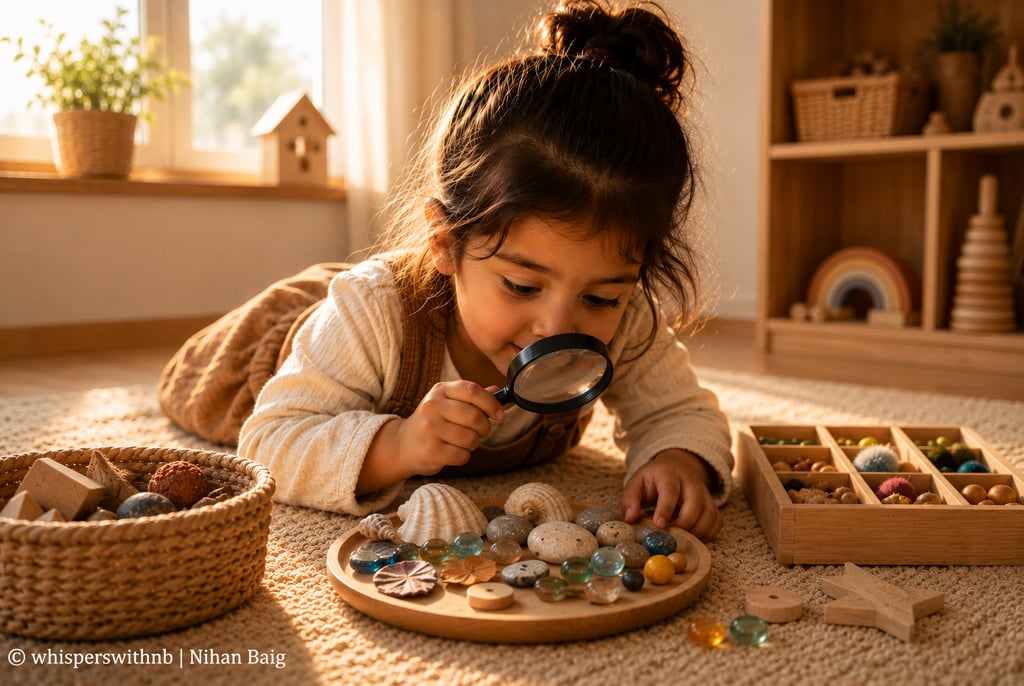
One of the most beautiful things about childhood is that children arrive in the world naturally curious. They are not born waiting to be taught what to think; they are born eager to discover. Every "Why?", "How?" and "What happens if...?" are invitations to explore a world that still feels wonderfully new. Before children ever memorise facts or complete worksheets, they begin learning through curiosity.
Anyone who has spent time with young children knows that questions seem endless. They ask why the sky changes colour, where the moon goes during the day, why birds sing, why leaves fall, and why people feel sad. To an adult, these questions may sometimes feel repetitive or exhausting. To a child, however, they are the building blocks of understanding. Every question is their way of making sense of a world they are only just beginning to know.
Curiosity is far more than asking questions. It is reaching out to touch a rough tree trunk, mixing colours to see what happens, turning over a stone to discover what lives beneath it, or taking apart a toy simply to understand how it works. Children learn best when they are actively involved in the process of discovery. Their minds are not empty containers waiting to be filled; they are active explorers searching for meaning in everything around them.
In today's world, it can be easy to feel pressure for children to achieve more, earlier. We celebrate reading at younger ages, counting higher numbers, and mastering new skills as quickly as possible. While learning academic concepts is important, rushing children from one milestone to the next can sometimes leave little room for the very quality that makes learning meaningful, curiosity itself.
A curious child is not only gathering information; they are developing habits that will serve them throughout life. They learn to observe carefully, think critically, solve problems creatively, and remain open to new ideas. These qualities cannot simply be memorised. They grow through opportunities to explore, experiment, make mistakes, and try again.
Some of the richest learning happens in moments that appear wonderfully ordinary. A walk through the park becomes a science lesson as children notice insects, leaves, clouds, and changing seasons. Baking together introduces mathematics through measuring and counting. Building with blocks teaches balance, persistence, and engineering without a single formal lesson. Everyday life is filled with opportunities for learning when curiosity is allowed to lead the way.
As adults, we have an important role not to provide every answer immediately, but to protect and encourage a child's desire to keep asking. Sometimes the most powerful response is not, "Here's the answer," but, "That's a wonderful question. What do you think?" Those simple words invite children to wonder, investigate, and trust their own thinking.
Curiosity also flourishes in environments where children feel emotionally safe. When they know their ideas will be welcomed rather than criticised, they become more willing to take risks, ask questions, and explore unfamiliar ideas. They learn that mistakes are not failures but valuable parts of the learning journey. Confidence grows not from always being right, but from knowing it is safe to keep trying.
Perhaps the goal of early childhood is not simply to teach children as many facts as possible. Perhaps it is to help them fall in love with learning itself. Facts can be forgotten and information can change, but a curious mind continues to seek, question, imagine, and grow throughout life.
Every great learner begins with a simple sense of wonder. It starts with muddy hands, endless questions, imaginative play, and the courage to explore what is not yet understood. When we protect a child's curiosity instead of rushing their achievements, we give them something far more valuable than early success. We give them a lifelong love of learning, one that will continue opening doors long after childhood has passed.